Juno Shows Jupiter Lightning Builds in Steps Like Earth Lightning
Trill News Briefing
The Story
Lightning on Jupiter forms in the same stepwise way as lightning on Earth, NASA's Juno spacecraft has found, despite the planets' vast differences.
A team with lead author Ivana Kolmašová of the Institute of Atmospheric Physics at the Czech Academy of Sciences studied five years of Juno data and published the result in Nature Communications in May 2023.
Juno's Waves instrument collected ten times more lightning radio emissions than Voyager 1, Voyager 2, Galileo or Cassini, picking out signals as little as one millisecond apart.
Those signals showed air in Jovian clouds charging up in distinct steps, each possibly several hundred to a few thousand meters long, the same way lightning forms on Earth.
Where the storms strike is another matter: Jovian lightning clusters at midlatitudes and near the poles, skips the equator and favors the northern hemisphere, while Earth's lightning concentrates near the equator and almost never reaches the poles.
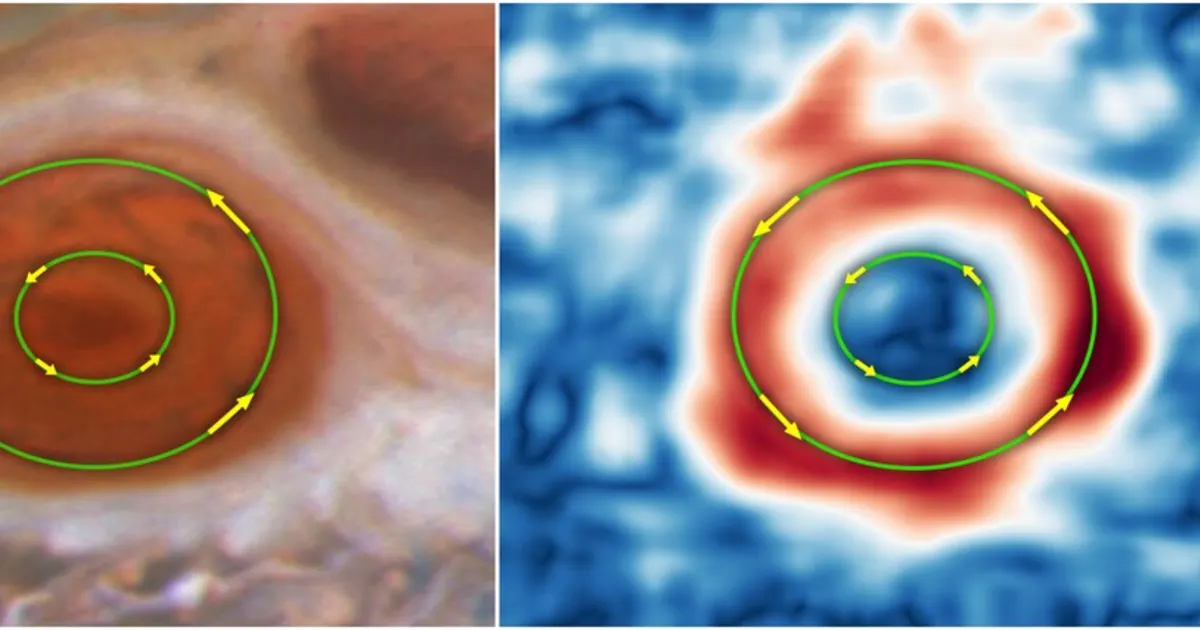
Kolmašová says that points to very different conditions for forming thunderclouds on the two worlds, and no one yet knows why the Great Red Spot has shown no lightning at all.
Why It Matters
Power was the next question. Over 12 passes in 2021 and 2022 Juno logged 613 microwave pulses, the strongest at least 100 times an Earth bolt, in a study published March 20, 2026, Ars Technica reported. Lead author Michael Wong asks whether Jupiter's hydrogen air, where moist air sinks, or taller storms explain the extra power. Answers cost money: NASA spent about $260 million in 2025 on Juno and four Mars missions, enough for two Discovery missions a decade, its planetary science chief says, and in March it had not said whether Juno flies on. Congress is expected to restore most planetary science funding in the 2027 budget, Ars Technica reported in October; whether any reaches Juno is unsettled.
Go Deeper
Read the original reporting at Space.com.
Read Full Story at Space.com →